Creator Positioning Checklist: Define Your Niche, Message, and Market Fit
Strong positioning helps a creator get remembered, recommended, and paid—without constantly chasing trends. It’s the difference between “a person who posts content” and “the go-to creator for a specific outcome.” A practical checklist makes positioning measurable: who the content serves, what problem it solves, what makes the perspective different, and how that translates into content pillars, offers, and profile messaging. The goal is clarity that holds up across platforms, formats, and collaborations. Use the sections below to audit what’s already working, tighten what’s vague, and turn your strengths into a repeatable identity that viewers can describe in one sentence.
Positioning in one sentence
Start with one sentence you can repeat everywhere: bio, pitch emails, podcast intros, and pinned posts. The simplest structure is audience + problem + promise + proof point (or differentiator).
- Make it outcome-based: focus on what changes for the viewer after following or buying.
- Swap broad labels for real contexts: instead of “lifestyle,” try “busy nurses,” “new freelancers,” or “first-time home cooks.”
- Stress-test it: after three posts, could a stranger repeat your sentence accurately?
- Add a “not for” line: a quick boundary protects clarity (who you’re not aiming at or what you don’t cover).
If you want a plug-and-play template to tighten this fast, the creator-positioning-checklist walks you through the sentence, boundaries, and the supporting pillars that make it believable.
Audience clarity: one person, one moment, one need
Vague audiences create vague content. Clear audiences create recognizable content—because the examples, constraints, and tone match what that person is living through.
- Define your primary audience by role + stage + constraint: “newly promoted managers with no time,” “college seniors with low confidence,” “DIY beginners on a tight budget.”
- Name the moment of urgency: what triggers the search, scroll, or DM (missed deadline, breakup, paycheck shock, confusing app update, first client call).
- Collect their top five questions in their words: use comments, DMs, forums, and Q&A stickers.
- Choose one core pain and one core desire: the pair that repeats most often becomes your anchor.
- List competing alternatives: other creators, free templates, apps, coworkers, old habits—these are your real competitors for attention.
This aligns well with classic segmentation and targeting thinking: pick a group you can serve, then position around a clear promise. For background, see the American Marketing Association’s overview of Segmentation, Targeting, and Positioning (STP).
Differentiation that doesn’t depend on being “unique”
Being “unique” is fragile. Differentiation is sturdier when it’s built on choices you can repeat: method, tone, constraints, and proof.
- Pick an angle you can own: a framework, a taste level, a tool stack, a beginner-first approach, an evidence-led style, or a constraint (no ads, no fancy gear, under-30-min routines).
- Inventory your proof assets: results, credentials, lived experience, case studies, before/after receipts, or a consistent track record.
- Draw a line in the sand: what you refuse to do (tactics, aesthetics, claims) and why.
- Map three comparable creators: write one sentence for how your promise or method differs.
- Choose 2–3 signature phrases: not slogans—clear concepts you repeat so your audience remembers the way you explain things.
Good positioning is often about “owning a word” in someone’s mind—one clear association—rather than trying to cover everything. A helpful summary of the idea is available via Positioning: The Battle for Your Mind.
Content pillars that connect to outcomes
Pillars keep your content from drifting. They also make your “one sentence” true over time, because each pillar supports the same promise from a different angle.
- Set 3–5 pillars: common ones include education, proof, process, personality, and product/offer.
- Define an outcome per pillar: what the viewer learns, feels, or can do afterward.
- Build repeatable series formats: “Fix this in 60 seconds,” “Before/after audits,” “Myth vs reality,” “Templates in action.”
- Balance discovery and trust: quick wins for new viewers, deeper context for loyal followers.
- Create a content boundary list: a short “we don’t cover that” list prevents dilution.
Positioning-to-content map
| Positioning element | What it must communicate | Content examples |
|---|---|---|
| Audience | Who it’s for + when they need it | “If you’re a ___ who struggles with ___, start here” |
| Problem | The specific pain you solve | Mistakes, audits, teardown videos, quick fixes |
| Promise | The result they can expect | Before/after stories, step-by-step walkthroughs |
| Differentiator | Why your approach is distinct | Framework breakdowns, comparisons, behind-the-scenes process |
| Proof | Why they should trust you | Case studies, testimonials, documented experiments |
Offers and monetization alignment
Positioning isn’t complete until it connects to something you can sell—without confusing your category. Your offers should feel like the natural “next step” of the content.
To connect the dots between content and income, pair your positioning work with multiple-revenue-streams-a-creators-manual so your monetization expands without pulling your brand in five directions at once.
Profile and messaging audit
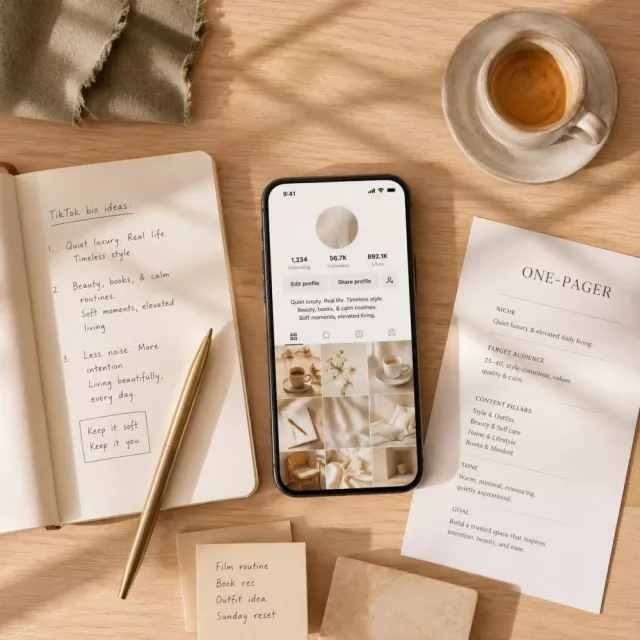
If TikTok is a primary channel, tighten your first impression with the tiktok-bio-profile-checklist so your bio, pinned posts, and calls-to-action all point to the same promise.
FAQ
How specific should creator positioning be?
Specific enough that a viewer can quickly tell who it’s for and what result they’ll get; broad enough to support multiple content ideas and offers without contradicting the promise.
Can positioning change over time without losing followers?
Yes—make shifts by keeping the same audience or same problem while evolving the method; communicate the change with a clear “why,” and update pillars and pinned posts to match.
What’s the fastest way to test if positioning is working?
Check if new viewers describe you accurately in comments or DMs, if your highest-performing posts align with your pillars, and if inquiries and brand offers match what you want to be known for.